
by Elise Mattiske
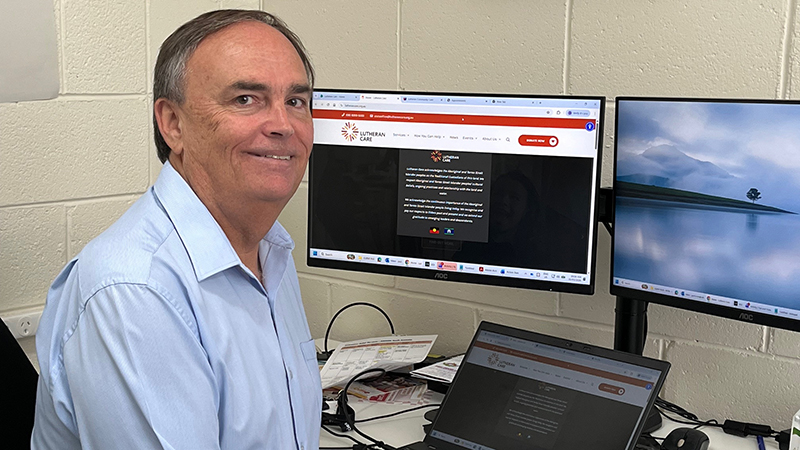
Seeing how small acts of care can change a life has shaped the way financial counsellor Peter Schirmer walks alongside people experiencing hardship today.
He spent the first eight years of his life in India, among communities where survival was often uncertain and daily life was shaped by adversity.
One story, told and retold in his family, left a lasting impression on his life.
A young mother once came to his family’s home with an infant suffering from malnutrition. Peter’s own mother responded with a simple act of care, supplementing the baby’s feeding with milk formula. Over time, the child recovered.
Years later, when Peter’s family returned to India to visit, they met that same mother and her child, now a healthy young man.
‘It was a very poignant moment,’ Peter says. ‘It impressed on me how even seemingly small acts of mercy can have lifelong positive consequences.’
That ‘thread of service’ has run through his life ever since – from years working with Australian Lutheran World Service, including in disaster response and refugee support, to senior leadership roles in the Lutheran Church of Australia and New Zealand (LCANZ), and now into the deeply personal work of financial counselling with Lutheran Care, a community services organisation supporting vulnerable people in South Australia and the Northern Territory.
After nearly a decade as executive officer of the LCANZ, he began to reflect on what the next stage of life might look like. Rather than stepping away into retirement, he felt drawn closer to the frontline.
As cost-of-living pressures intensified across Australia, Peter saw a growing need, not only among those familiar with financial hardship, but also increasingly among families facing it for the first time.
Encouraged by the insights of an experienced financial counsellor, he recognised that his own experience could be harnessed in a more personal way.
‘It felt consistent with that same thread of service,’ he says. ‘The only “downside” was that I had to re-engage the academic side of my brain and complete a diploma of financial counselling!’
Peter lives in Adelaide with his wife, Janette, and is a member of Glynde Lutheran Church, a community he values for its rich cultural diversity. His work with Lutheran Care is varied and often complex.
Financial counsellors offer free, confidential and non-judgemental support to people experiencing financial difficulty. The role is not to direct clients, but to equip them with options and walk alongside them as they make decisions.
A typical day might involve negotiating with utility companies, setting up hardship arrangements with creditors, helping someone build a workable budget or connecting clients with concessions and support services.
Often, the challenges go far beyond finances. Peter engages with a wide cross-section of society, including people who have experienced domestic and family violence, relationship breakdown, job loss, disability or long-term financial stress.
And yet, he is careful to emphasise what he sees beyond the hardship.
‘In these people, I see not only their challenges and problems, but individuals with strengths and potential,’ he says.
Even when outcomes fall short of what someone hoped for, the goal remains the same: that they are treated with dignity, given a ‘fair go’ and achieve the best possible result that offers them hope for the future.
‘I feel a great sense of privilege to meet people who have been brave enough to come forward and seek help,’ Peter says. ‘It is not an easy step to take, especially when they may be experiencing feelings of failure and vulnerability.’
There is also a responsibility to listen well, to recognise the strengths each person brings and to walk alongside them to find the best outcomes for their circumstances.
‘It can be challenging and confronting but always underpinned by a sense of hope that this person is loved by God,’ he reflects, ‘and that I’m part of his mission to share it through practical action.’
One encounter, in particular, has stayed with Peter.
A single mother with four children came seeking help, overwhelmed by debt and mounting pressure from creditors. Through negotiation, those debts were waived on compassionate grounds, lifting an immediate burden.
At a follow-up appointment, she brought a stack of unopened letters, too afraid to face what they might contain. Together, they opened them.
Inside were multiple traffic fines, now totalling more than $3,000, with the risk of losing her licence and car registration.
‘That would have had significant consequences for her day-to-day life and wellbeing: school runs, access to shops, social engagement, the ability to find work,’ he explains.
Together, they worked out an affordable repayment plan, easing the pressure and preserving her independence.
‘It was a huge relief,’ he says.
Moments like that are why the work matters.
For Peter, hope is not abstract.
‘I see the sign of hope, which is Jesus,’ he says. ‘Through his suffering comes the promise of hope for everyone.’
That ultimate fulfilment may still lie ahead, but Peter sees its signs already.
‘I see it in the people I meet – people with God-given dignity, gifts and strengths,’ he says. ‘And I see it in the resources around us that help people move towards lives with less stress, greater dignity and more security.’
Sometimes, it begins with something as simple as opening a letter together or offering help when someone dares to ask.
Elise Mattiske is the LCA publications editor.
If you need financial help, support is available
Australia – National Debt Helpline
1800 007 007 | ndh.org.au
Domestic and family violence support (Australia)
1800RESPECT
New Zealand – MoneyTalks
0800 345 123 | moneytalks.co.nz
Shine Helpline (NZ)
0508 744 633 | 2shine.org.nz
Are You OK (NZ)
0800 456 450 | areyouok.org.nz