
by Karen Dymke
I spent my life working with words. As a teacher, presenter and facilitator, language was my calling and my craft – the tool I used to teach, encourage and connect with others. Now, slowly and unexpectedly, those words are slipping away.
I was brought up in a Christian family where church on Sunday was simply part of life, and from an early age, I wanted to be a teacher, just like my mum. I studied at Lutheran Teachers College in suburban Adelaide, and I taught in Lutheran schools before becoming what I often called a ‘teacher of teachers’, running workshops and facilitating professional learning across Australia.
Communication and language were central to my life and vocation. Words were my tools. Then something strange began to happen.
While presenting, I started mixing up pronouns – saying ‘she’ instead of ‘he’. Occasionally, I would say completely wrong words, like calling a glass an elephant, even though I knew perfectly well it was a glass. I felt as though I had lost my mojo. Something wasn’t quite right.
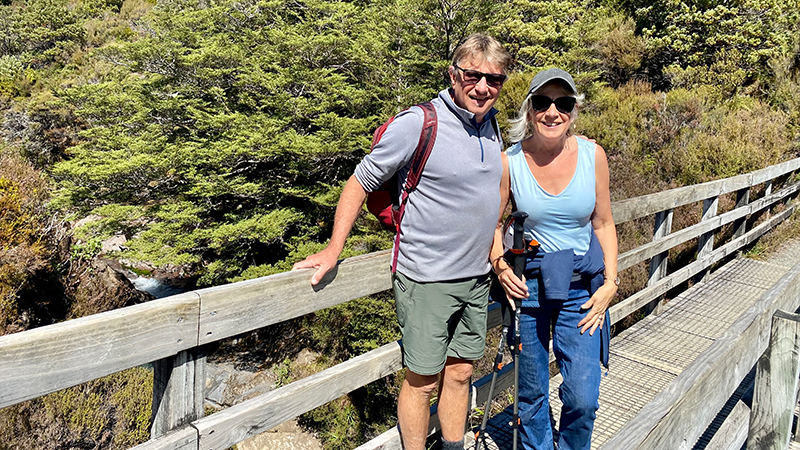
In response, I took what I called ‘long service leave’ – unpaid, because I ran my own consulting business, Thoughtful Works. My husband Jonathan and I travelled widely, exploring the Kimberley, hiking in New Zealand, crossing the Nullarbor, visiting Karijini National Park and even swimming with whale sharks at Exmouth. But every time we returned home, the problem picked up exactly where it had left off.
In the middle of a speech, I suddenly stopped – only for a few seconds, but it felt like five minutes. This was deeply unsettling for someone who had always had the gift of the gab. I used to say I could talk underwater with a mouthful of marbles. Suddenly, I was losing my words.
I saw an integrative doctor, worked with a trauma therapist and sought counselling support, wondering whether stress might be the cause. I also spoke with friends. One friend joked she had used up all her red wine in her youth. I half-believed I might have used up my words in the same way.
I continued presenting professionally, although I knew something wasn’t right. One day after a workshop, a woman said quite bluntly, ‘You are not as bright as you used to be.’ It hurt to hear, but she was right. Something was wrong.
Then, last April, everything changed. After a PET scan, the specialist told me I had frontotemporal dementia – the language variant.
He said I had seven to ten years to live. Seven to ten years. That is how calmly he said it, almost as if it were a weather report.
We left the office stunned, unable to breathe, let alone speak. We were encouraged to seek a second opinion.
Another specialist conducted further tests and explained the diagnosis differently. They said I had primary progressive aphasia, the non-fluent variant – a subtype of frontotemporal dementia. It was still difficult news, but it finally made sense.
The irony is not lost on me. I spent my life loving language, and now my brain is slowly packing it away, piece by piece.
Only about four per cent of people with dementia have this variant. Actor Bruce Willis has it too. I have always been a bit of a rare bird, so perhaps it is fitting that I would receive a rare diagnosis.
Writing is no longer easy. The words come more slowly, and speaking is harder still. But I still have stories to tell.
The diagnosis came the day before Good Friday. My husband Jonathan came to church with me, and we both sobbed as the whole congregation gathered around us. It was heartbreaking, and, somehow, very holy.
We have been grieving ever since, though that grief has changed over time. At first, it was overwhelming. Now, it feels more tender, even gentle.
Because my life and vocation had always centred on teaching and communication, I initially felt completely lost. I was not angry with God, but I was frightened. I found myself asking the ancient question: Why me? Where am I now, God?
So, I returned to something that had helped me before. I participated again in the Focused Living course at St Paul’s Lutheran Church Box Hill in Victoria, which I had first completed 10 years earlier. I began asking again: What is my purpose now? What is my calling?
The first answer was simple but profound: I am held in the arms of God. I am a beloved and baptised child of God. He made me, and he will sustain me.
What feels important now is contributing where I can and cherishing time with family and friends.
We continue to live fully. I have become a dementia advocate, speaking while I still can, and recently appeared in The Australian newspaper, highlighting that dementia is now the leading cause of death in Australia. My husband and I have also recorded a podcast called Holding the Moment, where we discuss intimacy and dementia. In July, we intend to travel to Vietnam with our whole family.
As I journey with Christ, I am learning to create a safe and loving space for myself, my family, my friends and my church community. I hope to bear witness to Jesus Christ through vulnerability and honesty, speaking courage, faith and hope into the lives of those around me.
Our pastor at Box Hill, who is himself living with stage 4 cancer, recently shared these words: ‘The Lord will fight for you; you need only to be still’ (Exodus 14:14).
To anyone facing illness, loss or uncertainty, I would say this: be brave if you can, be active if you can and stay connected as much as possible.
And when you cannot do those things, simply wait on the Lord.
As Paul writes in Romans, suffering produces perseverance; perseverance, character; and character, hope.
My life has certainly not gone as planned. Yet I can still say with deep gratitude that I have had a fortunate life, and through every unexpected turn, God has been with me.
And as I walk through the shadowed valleys ahead, my hope remains in him.
Karen Dymke is a retired educator, having taught in schools, TAFE and at La Trobe University, and is a member of St Paul’s Box Hill Vic.