
by Lyall Kupke
For more than 40 years, the Luther League was associated with the youth movement of the Lutheran Church in Australia.
This year marks the 100th anniversary of the formation of the Australian Luther League. Separate Luther Leagues existed in individual congregations before this; however, on 2 March 1926, delegates from 11 youth societies met in Gawler, South Australia, to form a combined organisation called the Australian Luther League. Those societies were Adelaide, Balaklava, Birdwood, Eudunda, Gawler, Hectorville, Rosedale, South Kilkerran, Tanunda, Tweedvale (Lobethal, as it was then known) and Waterloo (or Carlsruhe).
Youth organisations were not new in the church. In the 19th century, many congregations had them. They were known as the Jugendverein, Jünglingsverein or Jungfrauverein (youth society or young girls’ society). As English became the first language of most young Lutherans in Australia in the 20th century, they became the Lutheran Young People’s Society or Luther League. Some began as literary societies run by local communities or congregations.
All aimed to keep young people connected to the church and provide alternatives to popular secular forms of entertainment. The loss of young people from the church following confirmation was noticeable.
In the 1920s, both Lutheran churches – the Evangelical Lutheran Synod of Australia (ELSA) and the United Evangelical Lutheran Church in Australia (UELCA) – supported this youth movement. The new generation of young Australian-born, English-speaking pastors led the formation of many youth societies in their congregations. But they existed individually. They began to look for a broader body to support them and bring them together.
The Australian Luther League became the peak body for the youth in the ELSA in 1926. A few years later, the UELCA formed the Lutheran Young People’s Association, and the South Australian branch was called the Luther League of SA.
The 1st Convention of the Australian Luther League was held at Bethlehem Lutheran Church in Adelaide on 6–7 October 1926. Twenty-eight youth societies were represented, including some from Victoria and New South Wales. The constitution was adopted and the executive committee elected: President Martin Kriewaldt, Vice-President William Thiele (from Melbourne, Victoria), Secretary Norman Schodde, Treasurer Will Temme and Pastor Otto E Thiele (from Horsham, Victoria).
The national church papers (The Australian Lutheran and Lutheran Herald) included regular sections for their youth. Within a few years, both churches were publishing dedicated youth periodicals. The ELSA produced the Luther League Monitor from 1932, while the UELCA published The Lutheran Youth from 1934.
Bible study or discussion on various topics was a priority for most meetings. The range of topics reveals the issues of concern of the day: ‘How can a young Lutheran benefit the community (and the church)?’, ‘What are the doctrinal differences between the ELSA and UELCA?’, ‘Is it permissible to play cards?’, ‘Should all war debts be cancelled?’, ‘Whom shall I marry?’ and ‘Mixed marriages and divorce’.
Following a short business session, meetings concluded with various social activities: recitations, music, singing, debates and, finally, supper. The topics for debate in the 1930s included ‘Will motor traffic finally do away with railway traffic?’, ‘Picture shows have an ill effect on the modern youth’ and ‘Drinking is a greater evil than gambling’. After that debate, the pastor reportedly warned against both evils!
Concerts were regularly organised, and neighbouring societies, even from the other synod, were invited to attend. Annual state conventions gave young people opportunities to meet, and many met their future spouses. Service in the church was also actively encouraged, with Sunday school teachers’ and young people’s conventions helping equip members for teaching.
Scholarships were established for students preparing for teaching and pastoral ministry, and the Australian Luther League later provided important support for deaconesses. Mission support was another significant aim, and letters from those involved in mission work were eagerly received by their home youth societies.
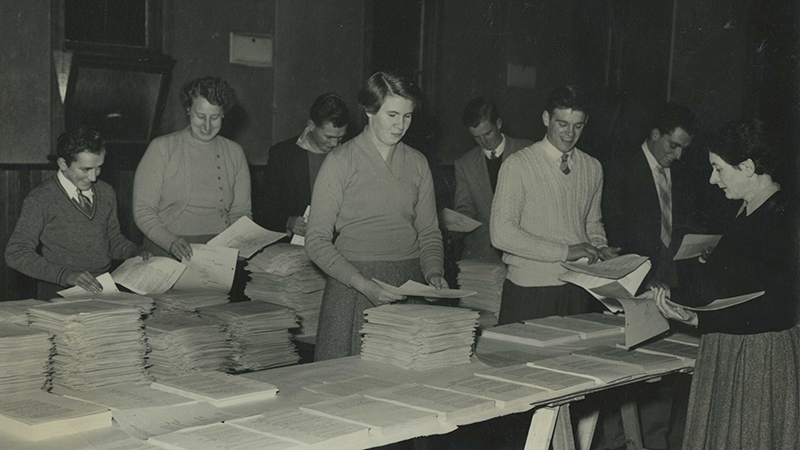
The Australian Luther League started Stamps for Mission in 1938, and the program continues today. Ern Unger, from Parkes, New South Wales, was the stamp receiver for 65 years. The first project was the building of hospitals in what is now Papua New Guinea. Luther Leaguers regularly held stamp cleaning and sorting nights.
The Luther League encouraged young people to become involved in their local congregations. In 1939, it was reported that the Walla Walla, New South Wales, church hall extensions had been planned, executed and financed almost entirely by the Lutheran Young People’s Society.
During World War II, youth societies kept in touch with those in the armed forces. Young people of the Bethlehem congregation in Brisbane hosted soldiers and nurses during the war, including many Americans, at the Lutheran Service Centre in their church hall. The youth of Nhill, Victoria, assisted staff from the Service Commission, which sent regular letters and literature to service personnel.
After the union of the two main Lutheran synods in 1966, the youth movement took on a different name and changes occurred. Many Luther Leaguers went on to serve in their local congregations or in the wider church. For more than 40 years, the Luther League and Lutheran Young People’s Society provided valuable training and experience, preparing many for a lifetime of service to the church.
Lyall Kupke served as LCA archivist from 1995 to 2014 and is a member of Zion Lutheran Church, Glynde SA.