
by Linda Macqueen
‘Hold up your right hand,’ I told a group recently. ‘Now touch your palm with your ring finger … but keep the other fingers pointing up.’
The young ones looked at me like I’d asked them to solve quantum physics before breakfast. Their fingers wobbled around like overcooked spaghetti. Meanwhile, the ‘old people’ – my people – executed the move with the grace of seasoned concert pianists.
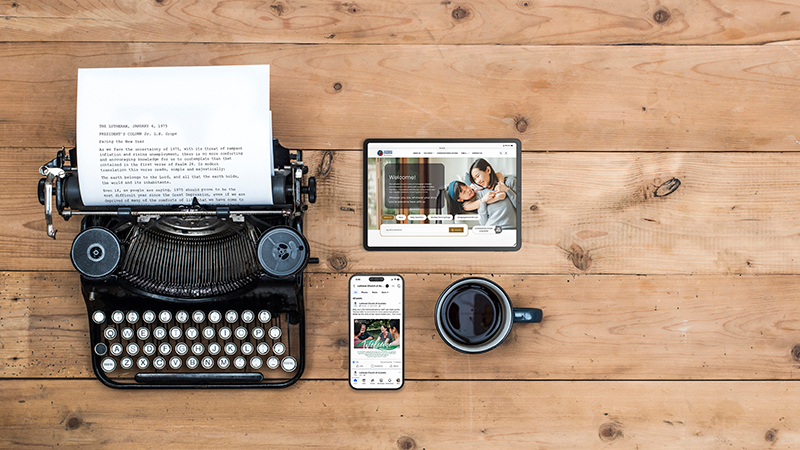
Why? Because we learnt to type on manual typewriters. Those machines were basically gym equipment with letters attached. If you didn’t develop strong ring fingers, you simply didn’t get through Year 10 Typing.
Of course, the younger generation has us beat in the thumb department. Their thumbs fly across their phones like caffeinated hummingbirds. Mine move with all the speed and confidence of a sleepy sloth.
But that’s the point: our bodies adapt to technology without us even noticing. So do our homes, our cars and our expectations. Most of us have welcomed these changes – even if we occasionally mutter about ‘kids these days’ while trying to remember our Netflix passwords.
So why, when it comes to technology in the church, do we sometimes get nervous? After 26 years in church communications, I’ve learnt that Christians can embrace new tools with confidence. God has been using human inventions for his purposes since long before any of us were born.
Back when communication meant paper cuts and postage stamps
When I started as editor of The Lutheran in 1999, the magazine was the LCA’s one and only official communication tool. One! Imagine that. Today, we have more channels and platforms than a smart TV knows what to do with. But back then, if you wanted to find out what was happening in Lutheran Land, you waited patiently by your mailbox for the next edition of your beloved magazine.
Everyone received the magazine automatically when they were confirmed. It was like a rite of passage: baptism, confirmation, The Lutheran subscription.
And honestly, it worked beautifully. People loved it because it was their only window into the wider church. No notifications. No inbox overload. No ‘I’ll read it later’ tabs that never get opened. Just a magazine, a cuppa and a quiet moment. Peace. Encouragement. Connection.
Then the digital floodgates opened
Fast‑forward a few years, and suddenly we had websites, email newsletters, videos, podcasts, livestreams and, of course, social media. Social media is a bit like Vegemite: some days you love it, some days you wonder why you ever let it into your life.
The challenge wasn’t just learning new tools – it was learning them at the speed they arrived. Just when you’d mastered one platform, another one popped up, usually with a name you couldn’t spell, much less pronounce.
And here’s the twist: more communication didn’t automatically mean better communication. In fact, people started drowning in it. Today, most of us want our news in tiny, snack-sized pieces we can skim between mouthfuls of Vegemite toast.
But the biggest change hasn’t been the technology. It’s been the rise of the echo chamber. People now curate their own little worlds of information and react strongly to anything that doesn’t fit. That’s not a tech problem – that’s a human‑heart problem, and those have been around since long before smartphones.
Every generation has its ‘newfangled menace’
Most people in the church have embraced new technologies because they were already using them everywhere else in their lives. Often, they were just waiting for the church to catch up – patiently, mostly.
That said, church people are traditionally cautious people. While browsing old editions of The Lutheran, I found a gem dating from the early days of television. The editor warned that TV would ‘pander to the lust of the eyes’ – which is a church‑magazine way of saying, ‘This thing might steal your soul.’
But, also, he admitted it had ‘wonderful and unlimited possibilities for good’.
Sound familiar? Every new technology arrives wearing the same two labels: Potential Danger and Potential Blessing.
Whether it’s television, the internet, smartphones or now artificial intelligence (AI), Christians have always had to decide whether to fear the tool or use it faithfully.
What hasn’t changed – and never will
The pace of change today is dizzying. Predicting what church communications will look like in 10 years is like predicting what teenagers will be wearing next summer.
But one thing has never changed: God communicates.
From burning bushes to handwritten letters, from the printing press to podcasts, God has always used the tools of the age to reach his people. Jesus himself is God’s ultimate communication – the Word made flesh.
Our job as Christian communicators isn’t to cling to old methods or chase every shiny new gadget. It’s to keep pointing to Jesus, saying, ‘Look – see how much God loves you’, using whatever tools God places in our hands.
Why we can embrace technology with confidence
If our fingers can adapt from typewriter keys to touchscreens, and if we are content for our cars to give us directions, book our dentist appointment and remind us to buy milk, then surely the church can adapt, too.
Technology isn’t the enemy. It’s a tool – one that can be used for good or ill, like every tool since the Garden of Eden. The printing press helped Martin Luther spread the gospel. Radio carried sermons into remote communities. The internet has connected congregations across continents.
And yes, even AI – the newest kid on the block – can be used by God in ways we can’t yet imagine.
We don’t need to fear the tools of our age. We simply need to use them wisely, humbly and with our eyes fixed on the One who never changes.
Because while the methods shift, the message remains the same: Jesus Christ came to save the world – and he still wants everyone to hear it and believe it.
Linda Macqueen served 26 years as editor of The Lutheran and communications manager for the LCANZ.